Thursday, October 10, 2019

'Louts, thugs, bullies': the myth that's driving Morrison's anti-union push

The most unionised occupation is teaching, the next most unionised is health care. Shutterstock
Anthony Forsyth, RMIT University
What have Scott Morrison and and Attorney General Christian Porter got in mind for unions?
The answer seems to be more of the same, more use of coercive power to make it harder for unions to fulfil their democratic functions of protecting workers and fighting inequality.
The newly-reintroduced Ensuring Integrity Bill was rejected in 2017, but the government thinks it’s got a better chance now, with the support of at least four of the six senate crossbenchers.
In part that’s because of the behaviour of John Setka, head of the Victorian branch of the Construction Forestry Maritime Mining Energy Union who has been convicted of using a carriage service to harass a woman.

Read more: View from The Hill: Now the senators are taking on John Setka

The Bill does not actually address Setka or his conduct, but the Government is using that negative impression to justify these new laws.
And it’s because of words like these, used by Justice Dyson Heydon, the royal commissioner tasked with examining trade union governance and corruption by the Abbott government:
it is clear that in many parts of the world constituted by Australian trade union officials, there is room for louts, thugs, bullies, thieves, perjurers, those who threaten violence, errant fiduciaries and organisers of boycotts
It’s also what the government wants people to believe about trade unions; that they are ugly, violent, law-breaking and self-interested.
In truth the most unionised occupation is teaching, the next most unionised is health care, and the third is protective services.

Why make it harder for teachers and nurses?

My research finds that there was a problem with union corruption the best part of a decade ago, most starkly apparent in the Health Services Union scandal, but for the most part unions have cleaned up their act.
I told the Senate inquiry into the Ensuring Integrity Bill that a proportionate response to the Royal Commission’s findings was warranted.
It included legislation imposing higher standards of financial management accountability on union officers, higher penalties for serious breaches of the Registered Organisations Act, criminal penalties for “corrupting benefits” and requirements for disclosure of benefits passing to a union under an enterprise agreement, clearer governance standards for separate entities and union funds such as election funds, and a specialist regulator for registered organisations.

Read more: Fall-out from Setka affair could give Coalition easier passage of union bill

Almost all of these measures have now been implemented. So what are we to make of the reheated Bill? It looks like an opportunistic attempt to take down unions.

Morrison needs an agenda

The government didn’t expect to be re-elected. Its business mates are demanding industrial relations reform. They want to shut down powerful unions like the Construction Forestry Mining Energy Union. The government tried to stop it merging with the Maritime Union to become the CFMMEU rather than the CFMEU, but the Bill didn’t get through parliament in time.
With that objective frustrated, business wants new weapons to take on unions.
Hence the provisions in the Bill enabling employers, the minister and the Registered Organisations Commission to seek the disqualification of union officials and the deregistration of unions; provisions that could prove very handy in an industrial dispute, adding to the already extensive range of weapons employers already have access to.

Read more: Grattan on Friday: Morrison government solid on industrial relations reform but bootlicks One Nation on family law

The Bill massively over-reaches. The government claims it’s simply applying to unions the same regulatory standards that apply to corporations. But its application of the corporate model is highly selective.

So it’s one rule for unions

Schedule 1 would allow court-ordered disqualification to be sought against a union official on much wider grounds than those available for company directors.
An employer could seek to have an official removed because they have been involved in a technical breach of the protected industrial action rules under the Fair Work Act, but a union could not seek disqualification of a company director who had breached the same legislation by, for instance, presiding over the underpayment of workers.
Disqualification could also be sought because a union official had breached the proposed “fit and proper person” test.
There is no fit and proper test for company directors, although there is for people providing financial advice and running businesses including labour hire businesses in Victoria.
The purpose of the latter test is to impose barriers to entry on dodgy and exploitative managers. There is no equivalent justification for prefventing someone becoming a union official.

Read more: Fall-out from Setka affair could give Coalition easier passage of union bill

Schedule 2 proposes new grounds for deregistering unions that partly mirror some of the grounds for court-ordered wind-ups of companyies under the Corporations Act.

Another rule for employers

But the addition of new grounds relating to a union’s (or members’) non-compliance with a wide range of laws has no equivalent in the Corporations Act.
Among the proposed grounds is “obstructive industrial action” – unprotected action that hinders of interferes with the activities of an employer or a public service, or that has a substantial adverse effect on community safety, health or welfare. Only a single instance would be needed.
The target of Schedule 2 seems to be the CFMMEU. But Commissioner Heydon neither recommended deregistration of the CFMEU nor proposed any change to the deregistration provisions.
The government already has the ability to seek deregistration of the CFMMEU under the Registered Organisations Act. Some of its grounds, including repeated breaches of court orders, would be sufficient in my view.
Instead of testing the existing law, the government has chosen to seek much wider grounds for deregistration and to give more parties, including employers, access to the mechanism, creating a threat to all unions, not just the CFMMEU.

And confusion about what unions do

The Coalition and employers can’t seem to make up their minds about unions.
They present them as both:
  • a relic of the past, facing imminent demise, representing only 15% of the workforce
  • a threat to the economy, with the merged CFMMEU threatening one part of the economy, and the proposed amalgamation of the National Union of Workers and United Voice threatening another.
The Ensuring Integrity Bill tells us it’s this second view that’s predominant, notwithstanding the reality that most unions play a valuable role in protecting vulnerable workers from exploitation, challenging managerial power in the workplace, and enhancing our democracy.The Conversation
Anthony Forsyth, Professor of Workplace Law, RMIT University
This article is republished from The Conversation under a Creative Commons license. Read the original article.


Thursday, October 3, 2019

The LabourStart Logo Competition

The LabourStart Logo Competition

LabourStart has had the same logo for 21 years (see above), and now we think it may be time to freshen things up a bit.
For that reason we're launching a new logo competition.
This competition is open to everyone.
Here is how it is going to work:

Submitting your logos

First, some technical details:

  • Image size: Please submit a logo that is 400 pixels wide and 200 pixels high. The logo must include the text 'LabourStart' (like the current logo).
  • Format: We will accept the following formats only: GIF, JPG, and PNG.
  • In addition, the winner of the competition should be prepared to send us one high-resolution version of the logo that we can use on printed promotional materials such as banners and t-shirts.
  • Please note that in submitting your logo to LabourStart, you are giving us the full rights to use the image. This must be an image you created, and for which you own the rights.

How to submit:

  • Please submit your logo -- just one logo per person -- using WeTransfer.
  • Make sure to include your correct email address.
  • In the Message box there, include your full name and country.
  • The deadline to submit your logo is midnight GMT on 31 October 2019.

What happens next

  • The members of the LabourStart Executive will review all the submissions during the course of November.
  • Designers whose logos made the shortlist will be notified by email.
  • LabourStart will release the shortlist by the beginning of December, at which point a public vote will take place online.
  • The winner will be notified by 31 December 2019.

Spread the word!

  • Please share this widely. The more people submit logos, the better the designs on our shortlist will be.
  • And thank you very much!

Wednesday, October 2, 2019

Flex time all Universities


Facebook icon Twitter icon Forward icon
Flex time all Universities
The CPSU-NSW, your union, is investigating member’s experiences with flexible work. In order to do so, we have created this survey. It will only take around 5 minutes and will provide valuable information that will help us best support you, and ensure that we are working on workplace issues that you care about.
You can fill in the survey here https://www.surveymonkey.com/r/UniFlextime
All information collected will be strictly confidential. If you have any questions or concerns, please don’t hesitate to reach out to your HERC delegates:
University of Sydney
University of NSW
Alistair Wareing
a.wareing@unsw.edu.au
Kate Brown
wk.brown@unsw.edu.au
University of Technology, Sydney
University of Western Sydney

University of Newcastle
University of Wollongong
Sian O’Sullivan
sian@uow.edu.au
Southern Cross University
Australian Catholic University
Richard Faulkner
Richard.faulkner@acu.edu.au
University of New England
Rob Webster
rwebster@une.edu.au
If your university isn’t on this list please feel free to contact kjackson@psa.asn.au.
If you know of any people that are members of the CPSUNSW please ask them to fill out this survey. If you know of anyone that isn’t a member of the CPSUNSW but wants a say, please ask them to sign up and we will get in contact with them. At the moment, this survey is only for members of the CPSUNSW.
We appreciate your time in reading this bulletin and filling out the survey. If you would like to get more involved please don’t hesitate to reach out to your local delegate, or email Kirra kjackson@psa.asn.au or Chris cbird@psa.asn.au, the two organisers for universities.

Wednesday, July 31, 2019

Shocking yet not surprising: wage theft has become a culturally accepted part of business

Australia’s Fairwork Ombudsman found wage theft in 45% of its audits In food services. www.shutterstock.com
Sarah Kaine, University of Technology Sydney and Emmanuel Josserand, University of Technology Sydney

Many Australians are shocked by celebrity chef George Calombaris being caught for underpaying employees A$7.8 million. It didn’t help, of course, that the television personality was also reported to be seeking a huge pay rise for appearing in the television program MasterChef Australia.

But what should not be a surprise is the prevalence in Australia of wage theft – typically underpaying award rates and entitlements such as overtime, superannuation and penalty rates.

Calombaris is not alone. In recent years there have equally large cases of wage theft involving household brand names such as Caltex, 7-Eleven, Pizza Hut and Domino’s Pizza.

The Australian Taxation Office estimated that in 2014-2015 Australian workers had been short-changed A$2.5 billion on superannuation payments alone .

Workplace audits by the federal Fair Work Ombudsman over the past decade suggest wage theft is rising. Most vulnerable are the young, the low-skilled and temporary migrants.


Read more: We've let wage exploitation become the default experience of migrant workers


And the sector where wage theft appears most common: food services (evident in more than 45% of audits).

Structure, culture, enforcement

The evidence points to wage theft being more associated with certain types of business structures. In particular, franchise operations, outsourcing, insecure work and the gig economy.

Calombaris has had a hard time denying he knew what happened in his companies. Bigger brands have gotten away with minimising costs through supply-chain arrangements where there’s exploitation somewhere along the line. It’s the very same problem that enables modern slavery to flourish around the world. These companies can deny responsibility because they have no direct legal obligations.

The problem isn’t just structural. It is also cultural.

Wage theft seems to have become accepted as a fact of life, maybe even a necessity, in certain sectors and workplaces. As a result, employers have developed a sense of impunity, while workers have become resigned to underpayment as unavoidable.

More than three-quarters of international students and backpackers, for example, know they’re being underpaid but accept it because they believe it’s standard treatment for anyone on their type of visa.

Cultural acceptance translates into weak enforcement rules. Wage theft is not considered a criminal offence, in the same way as stealing money from a company. Those caught face low penalties. Calombaris, for example, has to pay his employees what they are owed, but his penalty is limited to a $200,000 “contrition payment”).

Finally, a reform agenda

In this context – practices and attitudes making wage theft rampant – the only positive thing about Calombaris’ case is that, combined with other high profile cases, it has triggered enough outrage to make politicians get serious about reform.

The federal government has indicated it will propose new laws to make wage theft a criminal offence, punishable with prison time.

Along with tougher laws, more resources for enforcement are also needed.


Read more: Five myths about the informal economy that need debunking


Other reforms could help too. Supply chain certification, similar to the schemes used to guarantee fairtrade coffee or sustainably caught fish, are an example. The Fairwork Ombudsman has partnered with business and unions to create a pilot certification scheme for the cleaning industry.

Modern slavery legislation now requires large companies to report on their efforts to keep their supply chains slave-free. Acceptance of such reporting obligations could pave the way for the expectation that companies more attention to stamping out all forms of worker exploitation.

Community responsibility

There is one other notable point to make about the Calombaris case. It is about our own responsibility.

As a community we have collectively accepted wage theft for too long.

Collectively we seem to have higher tolerance for the mistreatment of workers at the fringes of the labour market – such as migrants, young workers and the low-skilled.

It is time to take stock. Work will change drastically in coming decades. More of us face the prospect of being among the vulnerable, with the jobs we do now being taken over by AI and automation.


Read more: Artificial intelligence-enhanced journalism offers a glimpse of the future of the knowledge economy


Technology has also facilitated “uberisation” and the growth of the gig economy, in which companies minimise their obligations by denying workers are employees.

Considering the breadth of change to come, we need more than ever to reflect on what we accept and enable.The Conversation

Sarah Kaine, Associate Professor UTS Centre for Business and Social Innovation, University of Technology Sydney and Emmanuel Josserand, Professor of management, Director of the Centre for Business and Social Innovation, University of Technology Sydney

This article is republished from The Conversation under a Creative Commons license. Read the original article.

Thursday, July 4, 2019

Dangerous anti-worker bills have just been introduced to Parliament

Scott Morrison’s IR Minister Christian Porter has just introduced two bills to attack working people – the Ensuring Integrity Bill that I wrote to you about last week – that would give Scott Morrison, big business and their lobbyists power to interfere with how unions are run, to disqualify union officers, to shut down unions, and stop unions from merging.

They have also introduced another bill the Proper Use of Workers Benefits Bill that would make it illegal for workers to run funds for things like insurance cover, redundancy protection, and training, just to name a few.

This is a serious attack on working people and the trade union movement.

Scott Morrison does not have a mandate to introduce these laws.

These laws will undermine workplace safety, increase wage and superannuation theft, and make it harder for workers to get pay increases and be represented when they need help.

They want to make it harder for unions to do our job of standing up for working people. When unions are under attack, all working people suffer. These bills must be stopped.
Because working people and unions have made contact with Senators about this, crossbench Senators have pushed for a Senate inquiry. That Senate inquiry is expected to report back in October, so the government can’t simply ram these laws through right now.

The inquiry buys us some time to build our campaign, but it’s not a lot of time.

I need you to join the campaign to stop Scott Morrison’s anti-union laws. 
We will need everyone to take action again in coming weeks to stop these anti-worker, anti-union laws in their tracks. 

Michele O’Neil
ACTU President
http://www.australianunions.org.au/

Friday, July 27, 2018

Tech innovators start to see old-fashioned benefits of collective bargaining


File 20180719 142420 ilynvu.jpeg?ixlib=rb 1.1
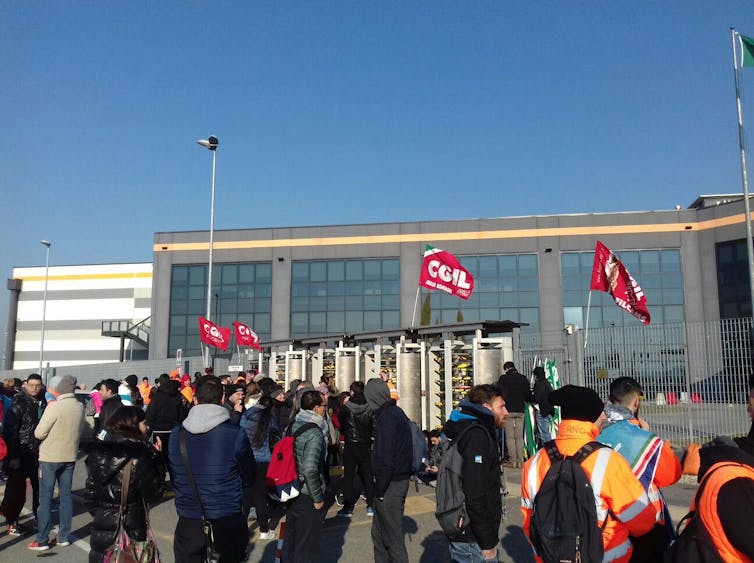
After a long industrial campaign, Amazon workers in Italy have persuaded their employer to reach an agreement with them. FILCAMS CGIL
Michael Walker, University of Technology Sydney
Disruption has been a defining buzzword of this decade, as companies in nearly all sectors find themselves challenged or supplanted as a result of the impact of technology. The beneficiaries of this disruption have mostly been newcomer enterprises – the Ubers and the Amazons – which have quickly grown to become part of everyday life.
Policymakers, reluctant to quash innovation, have taken a hands-off approach. But these innovators’ employment practices don’t appear to be so innovative. In recent times, however, some tech innovators have shown they aren’t allergic to bargaining with their workforce after all.
What’s driving this shift? It might be convenient for consumers but the gig employment model, with its arm’s-length relationship with its workforce, struggles to build organisational culture and relationships with customers. We see evidence of this in ongoing strife in companies such as Uber and Deliveroo.

Read more: Gig economy businesses like Uber and Airtasker need to evolve to survive

Now, though, major firms have begun to negotiate collective agreements with their workers.

Amazon in Italy

For the first time anywhere in the world, it was announced in May that Amazon had made an agreement with unions. The breakthrough took place in Italy, where Amazon and the FILCAMS CGIL union negotiated an agreement. It was endorsed by 70% of employees who voted on it.
The deal came into effect on June 17. It ensures fairness in scheduling and allocating weekend work, and reduces mandatory night shifts.
Amazon workers now get four consecutive free weekends out of every eight. Shifts alternate between Saturdays and Sundays, and they get 25% higher pay for working at night.


The Amazon warehouse and distribution centre in Piacenza, Italy, is now covered by a collective agreement with workers.

Digital media in the US

A growing number of digital news outlets have signed collective agreements with their writers over the last few years. The list includes Vice Media, ThinkProgress and the Huffington Post. All are now signed on to union contracts with the Writers Guild of America East.
In addition, Slate, Salon, MTV News and Fast Company recognise the Guild as a negotiating partner. Vox is negotiating its first union contract right now.
These contracts establish minimum salary and future pay rises, and set agreed payment for derivative republication of writers’ work. They also limit the power of management to fire employees at will.

Read more: Why HuffPo and other 'new' media journalists are choosing unions

A gig employer in Denmark

We have heard a lot about Uber, Deliveroo, Foodora and Airtasker and the problems created because they don’t treat their workers as employees. This means, among other things, they don’t provide the minimum wage or other basic employment standards. Airtasker has sought to address this by making undertakings to the peak union body in New South Wales.
By contrast, Danish employment platform Hilfr recently signed a collective agreement covering its workers, who provide cleaning services. Under the agreement, Hilfr’s workers will receive:
  • a minimum wage equal to A$30 an hour
  • pension contributions
  • holiday pay
  • sickness benefits.
The agreement was negotiated with Danish union 3F (United Federation of Danish Workers) and comes into effect on August 1.

Winds of change in Australia?

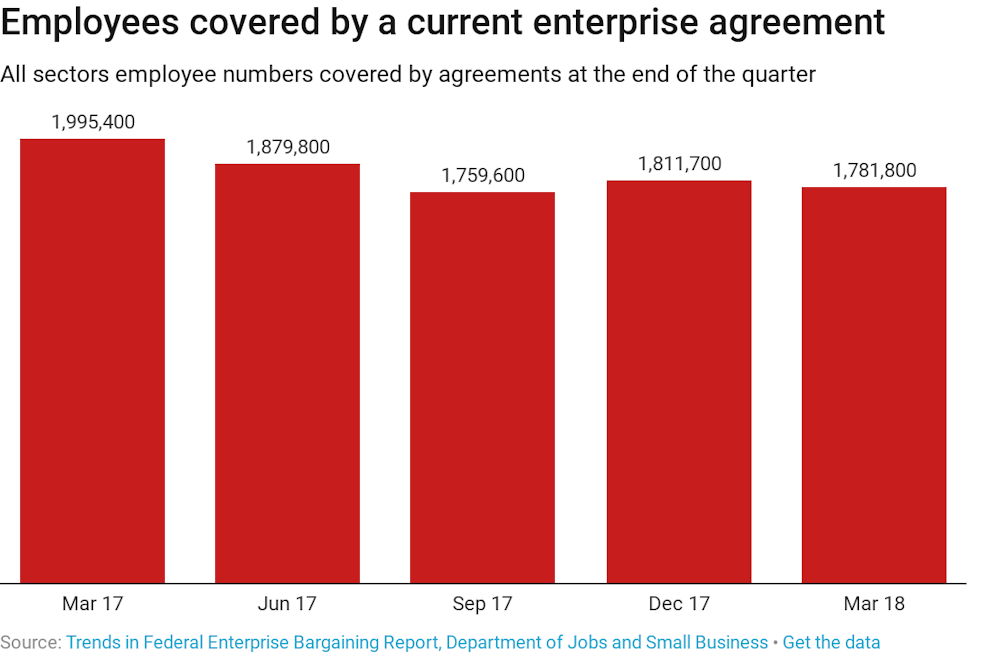
After years of decline, collective bargaining coverage in Australia has stabilised over the past 12 months.


These figures don’t include new agreements being made in the retail sector. These are set to add another 200,000 employees by the end of this year.
Meanwhile, the gig employment model faces the likelihood of increased regulation. The federal Labor Party has stated its intention to regulate gig employment if elected. Labor governments have starting doing so at state level.

Read more: Workers' compensation doesn't cover gig workers – here's a way to protect them

Gig employers have a strong incentive to sit down and talk – it could make for an uncomfortable ride for them if workers’ entitlements continue to be imposed through political agitation followed by legislation.
Perhaps it won’t be long until we see one of these tech innovators put in place such an “innovative” agreement with its Australian workers.
Michael Walker, PhD candidate researching worker voice, University of Technology Sydney
This article was originally published on The Conversation. Read the original article.

Friday, July 20, 2018

Members meeting to endorse the UTS Professional Staff Agreement


Summary
Despite a concerted push from Management, the new Agreement will see no loss of existing entitlements.  Positive gains for UTS Professional Staff include:
  • ·         2%pa pay increase (paid twice-yearly as 1% in May and 1% in November)
  • ·         Twice-yearly consultation meetings with University Management
  • ·         20 paid days of Domestic Violence Leave
  • ·         17% Supperannuation for all fixed-term staff from 2020
  • ·         Reference to Working From Home Policy captured within the EA
  • ·         Improvements to fixed-term and casual conversion
  • ·         Extended Redeployment for Professional Staff HEW 7 and below (now 20 weeks)
  • ·         Commitment to ongoing employment as the preferred mode of employment captured in EA
  • ·         New post-restructure implementation review process added to Change Management
  • ·         Increased Union training leave (now 10 days)
  • ·         Non-gendered Primary Carer Leave replaces Maternity Leave
  • ·         New Social Justice Leave category added to FACS Leave
  • ·    Additional $500,000pa held in a central fund for “next-level” Professional Staff training and      development